
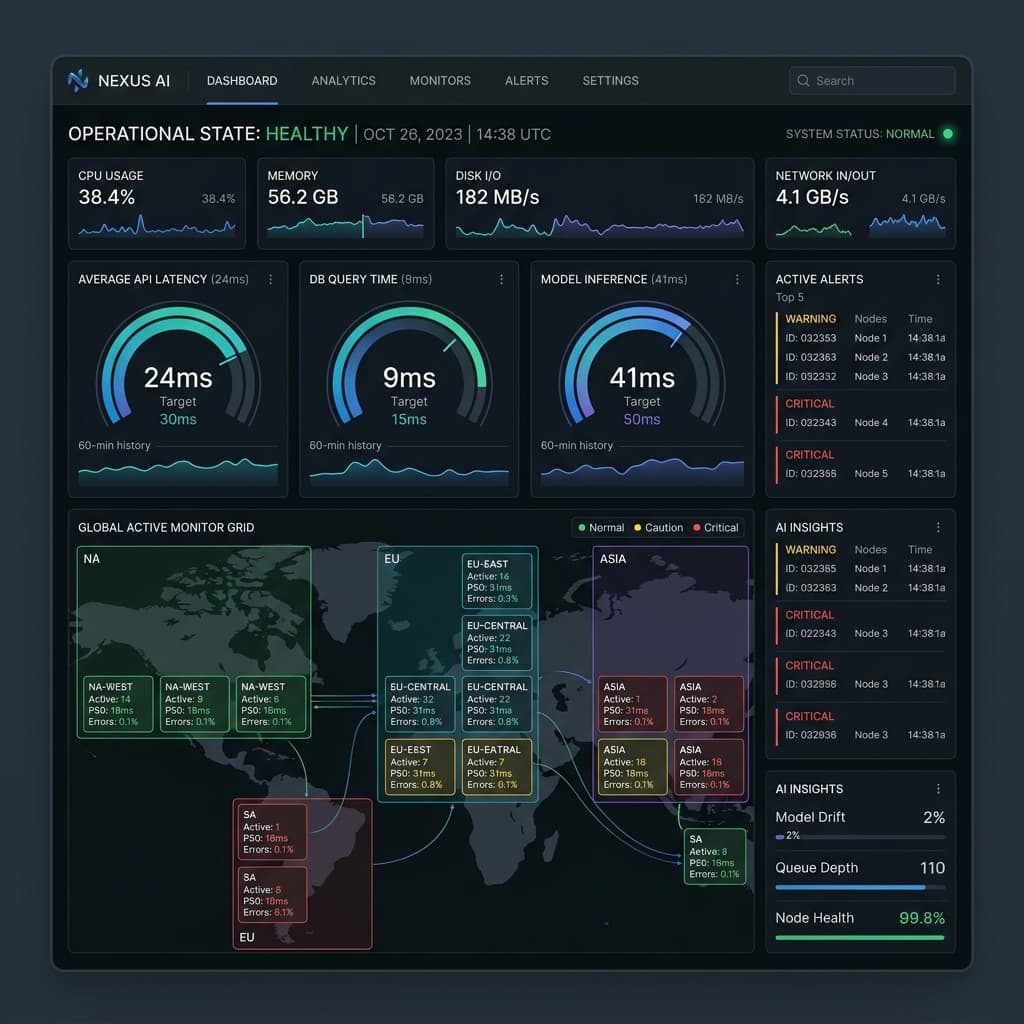
The Evolution from DevOps to AI Ops
AI Ops is the practice of managing AI-powered automation with the same operational rigor that DevOps brought to deployment — cost visibility, spend control, quality monitoring, provider management, and compliance audit trails. It exists because AI breaks every assumption traditional monitoring makes: outputs are non-deterministic, pricing is token-based and variable, and models get deprecated on provider timelines you don't control. Teams running production AI workflows need dedicated tooling and practices for this, not just another Datadog dashboard.
A decade ago, "deployment" meant SSH-ing into a server and running a script. Then containerization, CI/CD, and infrastructure-as-code emerged — and DevOps became a discipline with its own tools, practices, and career paths. The complexity demanded it.
AI-powered automation is at the same inflection point. Teams have moved from experimenting with one or two AI calls to running hundreds of AI-integrated workflows in production. The complexity has crossed the threshold where informal, ad-hoc management breaks down.
AI Ops is the emerging discipline that addresses this complexity. It borrows the rigor of DevOps — monitoring, alerting, runbooks, capacity planning — and applies it to the unique challenges of managing AI systems in production. It's not a rebrand of MLOps (which focuses on model training and deployment). AI Ops focuses on the operational layer: the calls your workflows make to AI providers, the costs those calls incur, the quality of the responses, and the reliability of the entire chain.
For automation teams, this isn't abstract. It's the difference between "we use AI in our workflows" and "we manage AI as a production dependency with the same discipline we'd apply to any critical infrastructure."
What Makes AI Operations Different
Traditional operations assumes deterministic systems: same input, same output, predictable resource usage. AI breaks every one of these assumptions.
Non-deterministic outputs. The same prompt with the same input can produce different responses on consecutive calls. This makes testing, debugging, and quality assurance fundamentally different. You can't write a unit test that checks for exact output — you need evaluation frameworks that assess quality on a spectrum.
Token-based pricing. Unlike compute (charged by time) or storage (charged by volume), AI is charged by tokens — a unit that varies with input complexity, output length, and model choice. A "simple" API call can cost anywhere from $0.0001 to $0.50 depending on these factors. This makes cost prediction and budgeting significantly harder than traditional infrastructure.
Model deprecation cycles. AI providers regularly deprecate models, often with 6-12 months notice but sometimes less. A workflow optimized for GPT-4-turbo needs to be migrated when that model reaches end-of-life. Each migration is a mini-project: test the new model, adjust prompts, validate output quality, update cost projections.
Provider rate limits. Every AI provider imposes rate limits (tokens per minute, requests per minute) that vary by model and tier. A workflow that runs fine at low volume can hit rate limits during peak hours, causing failures that look like bugs but are actually capacity issues.
Prompt versioning. The "code" that drives AI behavior is natural language, not traditional code. Prompt changes don't go through CI/CD pipelines, aren't tracked in version control (usually), and can have outsized effects on cost and quality. A five-word prompt edit can triple token usage or halve output quality.
None of these map to traditional monitoring, alerting, or capacity planning. That's why AI Ops needs its own tooling and practices.
The Five Pillars of AI Ops
After working with dozens of automation teams, we've identified five operational pillars that separate mature AI practices from ad-hoc ones:
Pillar 1: Cost Visibility. You can't manage what you can't see. Every AI call should be logged with its cost, attributed to a specific workflow and client/project. You should be able to answer "how much did we spend on AI last week, and what drove it?" in under a minute — this is exactly what per-workflow cost tracking delivers.
Pillar 2: Spend Control. Visibility without control is just expensive awareness. Budget caps, per-project limits, and alerting thresholds turn cost data into cost management. The key distinction is enforcement: alerts inform, caps protect.
Pillar 3: Quality Monitoring. AI responses degrade silently. A model update, a prompt regression, or a shift in input data can reduce output quality without triggering any traditional error. Quality monitoring means tracking response relevance, format compliance, and downstream success rates — not just HTTP 200s.
Pillar 4: Provider Management. Most production teams use multiple AI providers. Managing provider keys, monitoring rate limits, tracking model availability, and routing requests to the best provider for each task is its own operational domain. A provider outage shouldn't take down your entire automation stack.
Pillar 5: Compliance and Audit Trails. For agencies working with regulated clients or enterprise teams with governance requirements, every AI call needs an audit trail: what was sent, what was received, which model processed it, and when. This isn't optional — it's increasingly a procurement requirement.
Most teams start with Pillar 1 (cost visibility) and build upward. You don't need all five on day one. But knowing the full picture helps you build toward operational maturity incrementally.
Building an AI Ops Practice From Scratch
If you're starting from zero, here's a practical progression that balances value delivered against implementation effort:
Month 1: Visibility. Route all AI calls through a single gateway or proxy. Log every call with: timestamp, model, tokens (in/out), cost, latency, and a workflow identifier. Don't try to optimize yet — just get the data flowing. Most teams are shocked by what they discover in the first week of logging.
Month 2: Attribution and Alerting. Organize your logs by client/project and workflow. Set up basic alerts: daily spend exceeds threshold, error rate exceeds threshold, unusual model usage detected. Start a weekly review cadence where you spend 30 minutes looking at AI spend trends.
Month 3: Budget Enforcement. Based on two months of data, set budget caps for each client/project. Agencies managing multiple clients should start conservative — set caps at 120% of observed spend and tighten over time. The goal is to catch anomalies, not to restrict normal operation.
Month 4: Model Optimization. With three months of data, you can now identify optimization opportunities. Which workflows are using expensive models for simple tasks? Where are retries inflating costs? Which prompts are unnecessarily verbose? Pick the three highest-impact optimizations and implement them.
Ongoing: Review and Iterate. AI Ops is a continuous practice, not a one-time setup. Provider pricing changes, new models launch, client requirements evolve, and workflow volumes shift. The monthly review cadence from Month 2 should become a permanent fixture — it's the operational heartbeat that keeps your AI practice healthy.
The key insight is that you don't need a massive investment to start. A gateway, some logging, and a weekly review habit gets you 80% of the value. The remaining 20% — advanced routing, predictive budgeting, automated optimization — comes later, once you have the data and operational context to build on.
The Future: Autonomous Optimization
Where is AI Ops heading? The same direction every operational discipline eventually goes: toward automation of the operations themselves.
Intelligent model routing. Instead of manually choosing models for each task, the system evaluates cost, quality, and latency in real-time and routes each request to the optimal model. A classification task goes to Haiku. A generation task goes to Sonnet. A complex analysis goes to Opus. The routing adapts as pricing changes and new models launch.
Predictive budget forecasting. Based on historical spend patterns, workflow volume trends, and seasonal patterns, the system projects next month's AI costs before they happen. Agencies can proactively adjust client budgets or model selections rather than reacting to overages.
Self-healing workflows. When an AI provider experiences degraded performance or an outage, the system automatically fails over to an alternative provider. When a model is deprecated, the system suggests replacements based on task similarity and cost profiles. Operational disruption from provider issues approaches zero.
Cost-quality optimization loops. The system continuously evaluates whether cheaper models can handle tasks currently assigned to expensive ones. It runs shadow tests — sending a sample of requests to alternative models and comparing output quality. When a cheaper model passes the quality bar, it recommends (or automatically applies) the switch.
This isn't science fiction — pieces of this exist today, and the full picture is emerging rapidly. The automation teams that build strong AI Ops foundations now are the ones that will benefit most from these autonomous capabilities as they mature. You can't optimize what you haven't instrumented, and you can't automate what you haven't systematized.
The discipline is young, but the trajectory is clear: AI Ops will become as standard as DevOps for any team running AI in production.